
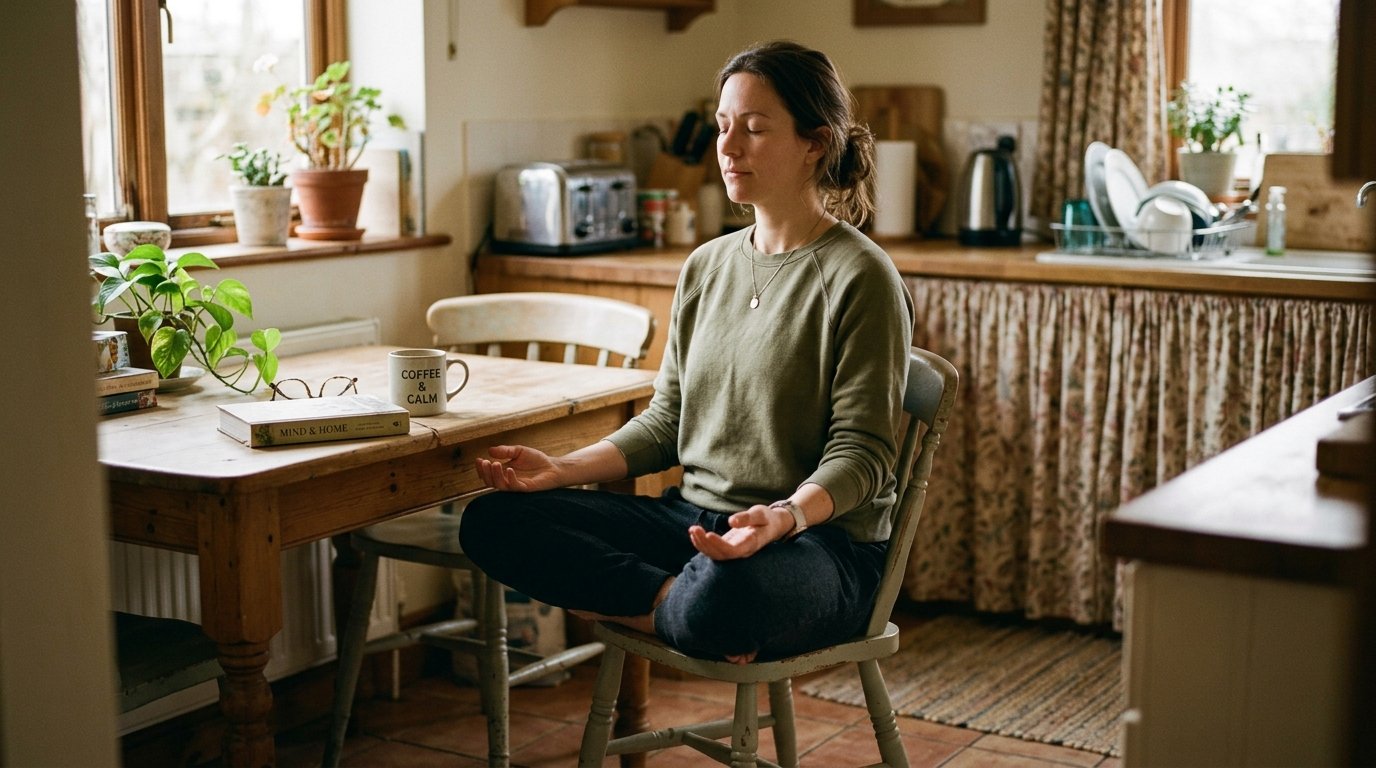
Last Tuesday morning, I was standing in my kitchen at 6:47 a.m., coffee in hand, phone buzzing with three unread emails, a school reminder about picture day, and a text from my mother asking if I could pick up her prescription. My chest was tight. My jaw was clenched. And somewhere in the back of my mind, a tiny voice whispered, “You should really meditate.”
I almost laughed. Meditate? With this to-do list? With this noise? The idea felt absurd, like suggesting I take a leisurely stroll while juggling flaming torches. I had tried meditation apps before. I had downloaded at least four of them, attempted a few sessions, and promptly abandoned them when my mind refused to cooperate. I was convinced that meditation was something other people did, people with quieter lives and calmer brains. People who did not have teenagers, aging parents, and a calendar that looked like a game of Tetris.
But here is what I have learned since then: the chaos is exactly why meditation matters. Not despite it. Because of it.
What Meditation Actually Is (and What It Is Not)
Let me clear something up right away, because this misunderstanding stopped me for years. Meditation is not about emptying your mind. It is not about achieving some blissful state of inner silence where you float above your problems like a serene cloud. If that is what you have been waiting for before you “start meditating properly,” you have been waiting for something that does not exist.
Meditation is simply the practice of paying attention, on purpose, to the present moment. That is it. When your mind wanders to your grocery list, your next meeting, or that awkward thing you said at dinner three years ago, you notice that it has wandered and you gently bring it back. No judgment. No frustration. Just a soft return.
The American Psychological Association describes mindfulness meditation as a practice that involves training attention and awareness in order to achieve mental clarity and emotional calm. Notice the word “training.” It is not a talent you are born with. It is a skill you build, the same way you build strength in a gym. And like any skill, it starts embarrassingly small.
The Three-Minute Practice That Changes Everything
I am not going to ask you to meditate for thirty minutes. I am not even going to ask you for ten. Here is the practice I want you to try tomorrow morning, before the emails and the school forms and the to-do lists take over.
Minute one: Arrive. Sit wherever is comfortable. Your bed, a kitchen chair, the edge of the couch. Close your eyes. Take three slow, deep breaths. Feel your shoulders drop away from your ears. Unclench your jaw. Notice that you are here, right now, in this moment. That is all you need to do. Just arrive.
Minute two: Breathe. Let your breath settle into its natural rhythm. Bring your attention to the sensation of breathing. Feel the cool air entering your nostrils, the gentle rise and fall of your chest. Your mind will wander. That is not a failure; that is the practice. Every time you notice your mind has drifted and you bring it back, you are doing a single repetition of the exercise. That is meditation.
Minute three: Expand. Widen your awareness slightly. Notice your body as a whole. Any tension in your shoulders? Any tingling in your hands? Any tightness in your stomach? You are not trying to fix anything. You are just noticing. Then gently open your eyes and carry on with your day.
Three minutes. That is it. And here is the thing that surprised me: it worked. Not in some dramatic, life-altering way. But in a subtle, accumulating way. Over a few weeks, I noticed I was less reactive. The school emails did not spike my heart rate quite as much. The traffic did not make me spiral. I had a tiny pocket of space between a trigger and my response, and in that space, I had a choice.
Why Consistency Beats Duration Every Single Time
There is a seductive myth that meditation only “counts” if you do it for a long time. Twenty minutes. An hour. An entire silent retreat in the mountains. But the research tells a very different story.
Studies published by the National Center for Complementary and Integrative Health (NCCIH), part of the National Institutes of Health, have found that even brief, regular meditation practice can produce measurable changes in stress response and emotional regulation. The key word is “regular.” Five minutes every day outperforms one thirty-minute session once a week.
Think of it like brushing your teeth. You would not skip brushing for six days and then brush for an hour on Sunday and expect your dentist to be impressed. The same logic applies to your mind. Daily, brief practice trains your brain to return to baseline more quickly. It rewires your default response to stress. And it does this far more effectively than occasional long sessions.
Research using MRI scans has shown that consistent meditators develop increased gray matter density in brain regions associated with emotional regulation, learning, and memory. At the same time, the amygdala, your brain’s threat-detection center, actually shrinks. These changes begin to occur with regular practice, even when that practice is just a few minutes a day. The growing use of wearables and AI-guided meditation among women over 35 is making this kind of consistent, evidence-backed practice more accessible than ever.
Why Women Over 35 Need This More Than Ever
If you are a woman over thirty-five, you are likely managing a particular kind of overwhelm. Career responsibilities, family obligations, possibly caring for aging parents, possibly raising children, possibly both. Your brain is operating in a state of chronic partial attention, juggling a dozen threads at once, never fully resting.
Meditation is not another item on your to-do list. It is the thing that makes your to-do list more manageable. It is the five minutes that make the other twenty-three hours and fifty-five minutes work better. It is not selfish. It is structural. You cannot pour from an empty cup, and you cannot think clearly from a scattered mind.
There is also something specific happening in our bodies as we move through our late thirties and forties. Hormonal shifts, even subtle ones, can amplify anxiety, disrupt sleep, and make us more reactive to stress. Meditation directly counteracts these effects by activating the parasympathetic nervous system, your body’s rest-and-digest mode. It lowers cortisol, reduces blood pressure, and improves sleep quality. The Mayo Clinic lists reduced anxiety, improved emotional health, and enhanced self-awareness among the documented benefits of regular practice.
Common Objections (and Why They Do Not Hold Up)
“I cannot meditate because my mind is too busy.” This is like saying you cannot go to the gym because you are out of shape. A busy mind is exactly why you practice. The moment you notice your mind has wandered and bring it back, you have just completed one successful repetition of the exercise. That is the whole practice.
“I do not have time.” You have three minutes. I know you do, because you spent three minutes scrolling through something on your phone this morning before your feet hit the floor. This is not about finding extra time. It is about using three minutes differently, once.
“I tried it and it did not work.” Meditation does not “work” the way a painkiller works. You do not take it and feel the results immediately. It works the way physical therapy works: gradually, through repetition, with benefits that accumulate below your awareness until one day you realize you are handling stress differently. Give it two weeks of daily three-minute sessions before you evaluate.
“I feel silly sitting there doing nothing.” You are not doing nothing. You are training your attention. That is one of the most productive things you can do for your mental health. And you are doing it privately, in your own home, with no one watching. There is nothing silly about taking care of your mind.
A Practice for Restless Days
Some days, sitting still feels impossible. Your body is fidgety, your thoughts are racing, and the idea of focusing on your breath feels like trying to nail jelly to a wall. On those days, try a body scan instead.
Close your eyes and bring your attention to the top of your head. Slowly move your awareness down through your forehead, your eyes, your jaw, your neck, your shoulders, your arms, your chest, your stomach, your hips, your legs, and your feet. Spend about ten seconds on each area, simply noticing any sensations without trying to change them. Warmth. Tension. Tingling. Numbness. Whatever is there is fine.
This practice is especially helpful when you feel disconnected from your body or stuck in your head. It grounds you in physical sensation and gives your busy mind something concrete to do. If sitting meditation is the anchor, the body scan is the rope that pulls you back to shore when your thoughts are pulling you out to sea. For more quick techniques, explore the best AI meditation apps of 2026, which offer personalized, adaptive sessions that meet you where you are.
How to Start (Without Overcomplicating It)
Here is my honest advice for starting a meditation practice. Do not buy a cushion. Do not download five apps. Do not create a spreadsheet to track your sessions. Just do this:
Set one alarm on your phone for tomorrow morning, three minutes earlier than you usually wake up. When it goes off, sit up in bed, close your eyes, and breathe for three minutes. That is your entire meditation practice. Do it again the next day. And the next. After a week, if you want to extend to five minutes, go ahead. If three minutes feels right, stay there. There is no prize for going longer.
The biggest mistake people make is turning meditation into another performance metric. Another thing to optimize, track, and feel guilty about. Do not do that. This is not a competition. It is a conversation with yourself, and it starts with three minutes of honesty.
Key Takeaway
You do not need an app, a cushion, or a silent room. You do not need to clear your mind or achieve enlightenment. You need three minutes, a willingness to sit with yourself, and the understanding that noticing your mind has wandered is not failure. It is the practice. Start there. Start tomorrow. Start imperfectly. Your mind has been waiting for this.