
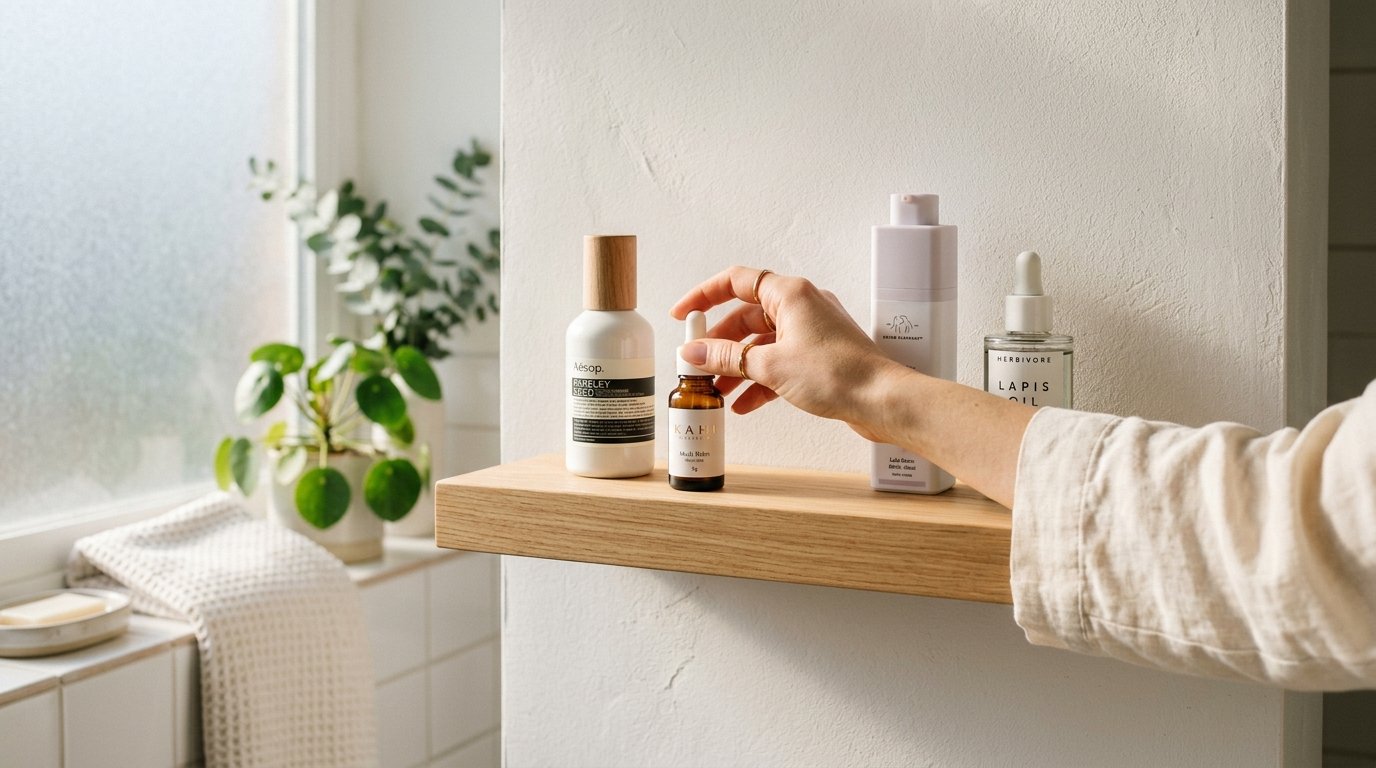
Last Tuesday morning, I stood in my bathroom staring at a shelf crowded with bottles, jars, and tubes. There was the vitamin C serum I kept meaning to use more consistently, the hyaluronic acid that felt redundant next to the moisturizer I already loved, and a toner I had bought in a moment of weakness at the airport. I had somewhere to be in twenty minutes. I picked up exactly four products, did my routine, and walked out the door. My skin looked better than it had in months. That moment crystallized something I had been learning slowly: the skincare routine that survives real life is the one simple enough to actually do every single day.
I am not against skincare. I am against the idea that more products automatically means better skin. For years, I cycled through elaborate multi-step regimens, convinced I was missing some crucial step. I was not. I was creating confusion, wasting money, and layering so many active ingredients that my skin barrier was quietly paying the price. When I finally stripped everything back to a focused, intentional routine, my skin responded with something it had not shown me in a long time: consistency.
The Myth of the Ten-Step Routine
The beauty industry has a financial interest in convincing you that your routine is incomplete. Every few months, a new product category appears: essences, ampoules, sheet masks, sleeping packs, eye serums, lip treatments with retinol. The message is always the same: you are missing something. But dermatologists have been pushing back on this narrative for years. According to the American Academy of Dermatology, an effective skincare routine for most people boils down to a handful of core steps: cleansing, moisturizing, and sun protection, with targeted treatments added only when specific concerns demand them.
The ten-step routine became popular through Korean beauty culture, and there is nothing inherently wrong with enjoying a luxurious ritual. But there is a difference between a ritual you choose and a routine you feel burdened by. When products start piling up, you run into real problems. Active ingredients can interact in ways that reduce their effectiveness or increase irritation. Retinol and high-concentration acids, for instance, should not be layered together. The more products you use, the harder it becomes to identify which one is actually working, and which one is causing that persistent redness on your cheek.
What My Skin Actually Needs
After years of trial and error, I landed on a core routine of four products: a gentle cleanser, a targeted treatment, a moisturizer, and sunscreen. That is it. The cleanser removes dirt and makeup without stripping my skin. The treatment, depending on the season and my skin’s mood, is either a vitamin C serum in the morning or a retinol at night. The moisturizer keeps my barrier intact. And sunscreen, non-negotiable, protects everything I am working toward.
This is not a radical idea. It is what most dermatologists recommend. Dr. Shereene Idriss, a board-certified dermatologist known for her evidence-based approach to skincare, has spoken extensively about how the overuse of active ingredients is one of the most common causes of skin irritation she sees in her practice. When your barrier is compromised from too many products, your skin cannot properly absorb the ingredients you are trying to deliver. You end up spending more money for less results.
The real breakthrough for me was understanding that consistency beats complexity every time. A routine of four products that you use faithfully every morning and night will outperform a ten-step routine you only manage three times a week. The research supports this: consistent application of sunscreen and retinoids produces measurable improvements in skin texture, pigmentation, and collagen density over time. Skipping steps or alternating randomly undermines those gains.
Building Your Minimalist Routine
If you are reading this and thinking your current routine has too many products, you are not alone. The transition does not have to be sudden. Start by asking yourself one question about each product you own: what is this specifically doing for my skin? If you cannot answer that clearly, it probably is not earning its spot.
The Non-Negotiables
Every effective minimalist routine starts with three pillars. First, a gentle cleanser that removes impurities without leaving your skin tight or dry. Look for fragrance-free formulas with a balanced pH. Second, a moisturizer suited to your skin type. Oily skin still needs moisture; lightweight gel formulations work well. Dry skin may benefit from richer creams with ceramides. Third, a broad-spectrum sunscreen with at least SPF 30. The Skin Cancer Foundation consistently emphasizes that daily sunscreen use is the single most effective anti-aging step you can take.
The Targeted Treatment
The fourth product is where personalization happens. If your primary concern is uneven skin tone or environmental damage, a vitamin C serum in the morning is well-supported by evidence. If fine lines and texture are your focus, retinol at night is the gold standard, backed by decades of dermatological research. For acne-prone skin, niacinamide offers oil regulation and barrier support without the harshness of some alternatives. The key is choosing one treatment that addresses your main concern, not three that compete for your skin’s attention.
You do not need to use vitamin C and niacinamide and retinol all at once. Pick the one that matters most right now. You can always rotate seasonally or as your skin’s needs change.
How to Know When Less Is Working
One of the most surprising benefits of scaling back is the clarity it gives you about your skin. When you use fewer products, you can actually track what each one does. If you introduce a new serum and your skin reacts, you know exactly which product is responsible. When you are layering eight different actives, that kind of attribution is impossible.
Give your simplified routine at least six to eight weeks before judging results. Skin cell turnover takes roughly 28 to 40 days, depending on your age, and visible changes in pigmentation or fine lines require consistent application over multiple cycles. The temptation to add another product after two weeks is real, but patience pays off. Your skin will tell you what it needs if you give it the quiet to speak.
The Ingredients Worth Knowing
Minimalism does not mean ignorance. Understanding what your products contain helps you make smarter choices and avoid redundant purchases. Here is a quick cheat sheet for the ingredients that actually earn their place.
Retinol
The most extensively studied anti-aging ingredient available without a prescription. Retinol accelerates cell turnover and stimulates collagen production. Start with a low concentration, two to three nights a week, and increase gradually. Always pair it with sunscreen during the day, as retinol increases photosensitivity.
Vitamin C
A potent antioxidant that neutralizes free radicals from UV exposure and pollution. It also inhibits melanin production, which helps fade dark spots over time. Look for L-ascorbic acid in concentrations between 10 and 20 percent. Store it properly; oxidation renders it ineffective.
Niacinamide
Vitamin B3 in skincare form. It strengthens the skin barrier, reduces redness, minimizes the appearance of pores, and regulates oil production. It is one of the most versatile ingredients available, pairing well with virtually everything else in your routine.
Hyaluronic Acid
A humectant that draws moisture into the skin, plumping it from within. It works for every skin type and layers well under moisturizer. If your skin tends toward dryness, applying it to slightly damp skin and sealing it with a moisturizer maximizes its effect.
Ceramides
Lipids that make up a significant portion of your skin barrier. After thirty, natural ceramide production declines. Adding ceramide-rich moisturizers helps reinforce that barrier, reducing sensitivity and transepidermal water loss.
When a Minimalist Routine Needs Reinforcements
Simpler is better, but not always sufficient. There are moments when your skin needs more targeted intervention than a basic routine provides. Persistent acne, melasma, rosacea, or sudden texture changes warrant a conversation with a dermatologist, not an impulse purchase at Sephora. No amount of niacinamide replaces professional evaluation when something is genuinely wrong.
The goal of a minimalist routine is not to ignore your skin’s complexity. It is to give yourself a stable, reliable foundation that you can build on when needed. Think of it as your daily baseline: the thing you do on your worst, busiest, most exhausted days. On your best days, you might add an extra mask or a facial oil. But the core four keep showing up, no matter what.
The Financial Freedom of Buying Less
Let us talk about the part the beauty industry does not love: saving money. A ten-step routine can easily run two hundred to four hundred dollars per month, depending on the brands you choose. A focused four-product routine might cost sixty to a hundred dollars, and many of those products last two to three months. Over a year, the savings are significant. More importantly, you stop buying products out of anxiety and start buying them out of intention.
That shift in mindset matters more than any single product. When you stop chasing the next miracle ingredient, you start paying attention to what your skin is actually telling you. You notice that your moisturizer works better in winter when you apply it to damp skin. You realize that your retinol does not need to be the highest concentration available. You discover that the best routine is the one you barely have to think about.
A Routine That Survives Real Life
The skincare routine that survives real life is not glamorous. It does not make for an aesthetically pleasing flat lay. But it works. It is the routine you do when you are tired, when you are traveling, when you are busy, when life gets complicated. It is four products that you trust, applied consistently, backed by evidence, and free from the noise of constant product launches and influencer recommendations.
I still enjoy skincare. I still read about new ingredients and try the occasional new product. But my baseline, the thing my skin can always count on, is four products. That is the routine that survived real life, and my skin has never been happier.
Key Takeaways
- An effective skincare routine for most women over 35 requires only four core products: cleanser, targeted treatment, moisturizer, and sunscreen.
- Consistency beats complexity. Using fewer products faithfully produces better results than a complicated regimen used sporadically.
- Understanding key ingredients like retinol, vitamin C, niacinamide, hyaluronic acid, and ceramides helps you make informed choices without unnecessary purchases.
- Scale back gradually. Ask yourself what each product specifically does for your skin, and eliminate anything that does not have a clear answer.
- A minimalist routine saves money, reduces irritation, and gives you clearer insight into what your skin actually needs.
For more on building routines that work with your lifestyle, explore Your Skincare Routine as Self Care and Metabolic Skincare: Why Beauty Starts from the Inside Out.
Written by Sarah Chen for March-8.