
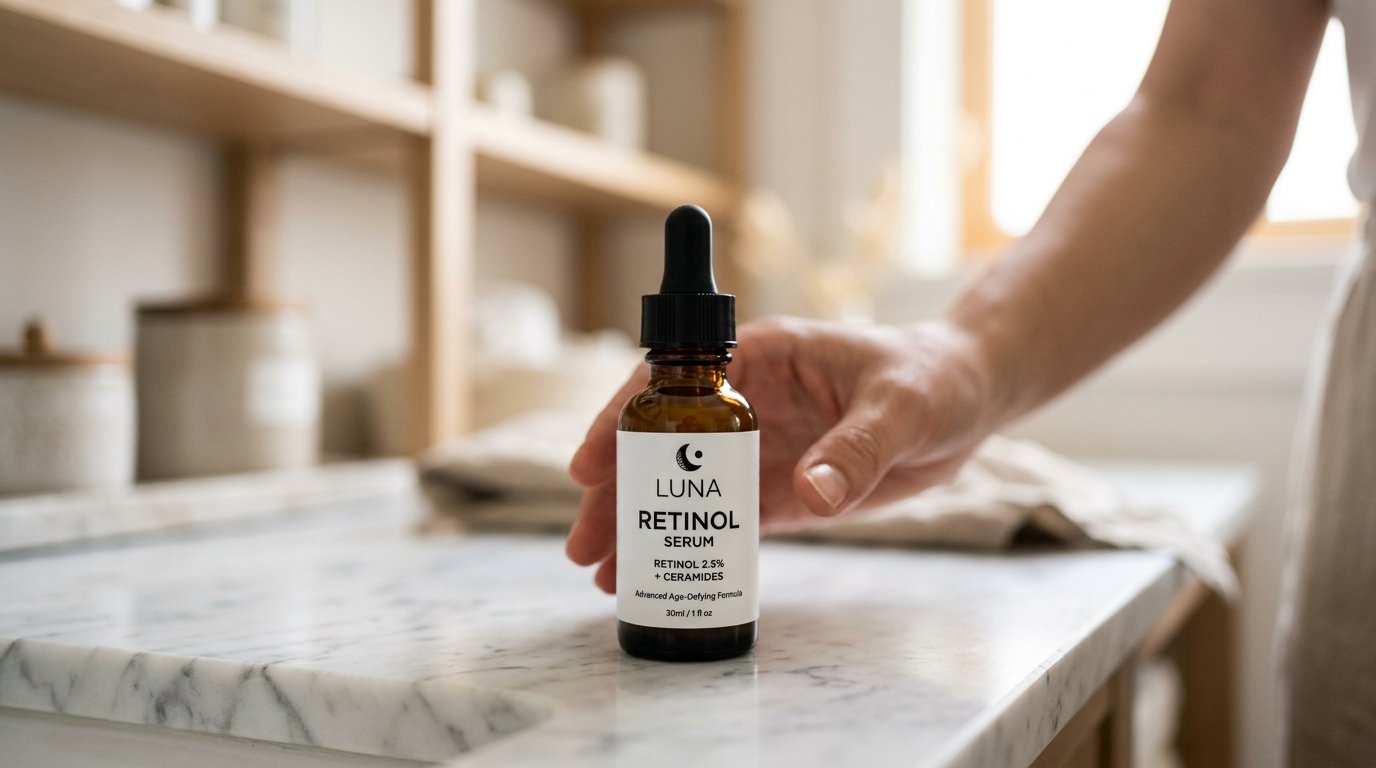
I nearly gave up on retinol in the third week. Not because it was not working, but because it was working too hard. My skin peeled, my chin turned red, and I looked, for a while, like I had embarrassed myself in the sun. A friend who is a nurse practitioner took one look and laughed gently. “That is the retinization phase,” she said. “You are right on schedule. Everyone quits exactly here.” She was right. I pushed through, and three months later my skin looked calmer and clearer than it had in a decade.
Retinol is often called the gold standard of anti-aging ingredients, and for good reason. It is one of the few skincare actives with real clinical evidence behind it, shown to soften fine lines, smooth texture, and support collagen production. But the peeking period, the redness, the peeling, and the moment of doubt all drive women to abandon it before results arrive. Understanding what retinol actually is, and what it is doing to your face, is the difference between quitting in week three and glowing in month six.
What Retinol Is Actually Doing to Your Skin
Retinol is a form of vitamin A. In simple terms, it speeds up the natural process by which your skin renews itself. Skin cells eventually die, rise to the surface, and are shed, and retinol tells those cells to behave more like younger cells, turning over faster, producing more collagen, and fading dark spots. It is not magic. It is a biological nudge that accelerates a process your skin already knows how to do.
The downside is that this acceleration can look like damage at first. The faster turnover pushes surface congestion upward, which can cause a temporary flare of breakouts, and the increased activity can leave skin dry, flaky, and red. This is the “retinization” window, and it usually lasts two to six weeks. The American Academy of Dermatology explains that this adjustment period is normal and signals the product is working, not that you have ruined your face.
How to Start Without Destroying Your Skin
The single biggest mistake is rushing. Retinol rewards patience and punishes enthusiasm, so the golden rule is to start low and go slow. Begin with one application per week for the first two weeks, then move to twice a week, then every other night, always letting your skin set the pace. A pea-sized amount is genuinely enough for the whole face, and using more does not mean faster results, it only means more irritation.
How you apply it matters just as much as how often. Apply retinol to completely dry skin, because damp skin absorbs it faster and increases irritation. Wait twenty minutes after cleansing, so your face has time to settle. And the well-known “sandwich method” exists because it works: a layer of moisturiser, then retinol, then another layer of moisturiser on top. The buffer softens the impact without meaningfully reducing the results, making it far more comfortable if you tend toward dryness, which many of us do after thirty-five.
The One Rule You Cannot Skip
Retinol makes your skin more sensitive to the sun, and no amount of careful layering changes that. The next morning, broad-spectrum sunscreen of at least SPF 50 is non-negotiable. It is the difference between retinol refining your skin and retinol quietly making sun damage worse. Most of us are diligent about the evening routine and less attached to the morning one; this ingredient is where that balance has to flip.
It also deserves an honest warning about your other actives. Do not use retinol on the same night as strong exfoliating acids like glycolic or salicylic acid, because the combination can overwhelm your skin barrier. Instead, alternate nights, or keep the acids for your morning line-up. Giving each active its own night respects the barrier that holds everything together. If you are just beginning, it can also help to keep a simple note of which nights are retinol nights and which are acid nights, because consistency across weeks matters far more than any single evening.
What Realistic Results Look Like
Retinol is a marathon, not a sprint, and knowing the timeline keeps expectations honest. In the first few weeks you may see irritation and even a temporary breakout as congestion surfaces, which is normal and temporary. By weeks four to eight, the texture typically begins to smooth out as cell turnover steadies. By the three-to-six-month mark, fine lines can visibly soften and dark spots fade, leaving skin brighter and calmer. If you are six months in and seeing nothing, it may be time to talk to a professional about a stronger formulation or a different retinoid variant.
For women over thirty-five, this ingredient matters more because collagen production naturally slows around this age, and retinol is one of the few over-the-counter ways to support it. If your skin cannot tolerate retinol at any strength, there are gentler cousins worth trying, including retinaldehyde or granactive retinoid, which are often better suited to sensitive skin and first-time users. The theme is the same across all of them: consistent, patient use beats aggressive, inconsistent use every single time.
Choosing a Strength and Product
Over-the-counter retinol typically ranges from about 0.1 percent up to one percent, and the number on the box does not tell the whole story. Higher percentages are not automatically better; they are more irritating and often no more effective in the long run. For most people starting fresh, a low-to-mid percentage applied consistently outperforms a high percentage applied sporadically because you will actually stick with the lower one. You can always step up later once your skin has clearly adapted.
Pay attention to the formulation, not just the percentage. A stable, well-formulated retinol in a properly packaged tube preserves its potency, while one exposed to air and light loses effectiveness quickly. If a product causes stinging that does not settle, or if the irritation is more than mild and temporary, treat that as information rather than as a sign to push through at all costs. Red, burned-looking, painful skin never results in better results; it results in a damaged barrier that eventually needs months of repair. There is no medal for suffering through retinoid irritation that should have been dialled back.
If over-the-counter options consistently irritate you, this is precisely when a dermatologist earns their fee. Prescription retinoids such as tretinoin can be prescribed at gentle starting strengths that are often better tolerated than people expect, and a clinician can also help you figure out whether retinol is even the right ingredient for your skin type or whether you should be looking elsewhere entirely. The goal is never to force one ingredient; it is to find the routine that your skin can maintain for years.
When Retinol Is Not the Right Choice
Retinol is powerful, but it is not for everyone, and a responsible guide names the exceptions. If you are pregnant or breastfeeding, most dermatologists advise avoiding oral and high-dose topical vitamin A derivatives due to safety concerns, so this is a conversation to have with your obstetrician or doctor before starting. The gentle pause of retinol here is not a setback; it is simply the right call for a season, and you can revisit it once the situation changes.
Likewise, if you have eczema, rosacea, or a very reactive skin barrier, retinol may not be kind to you regardless of how slowly you introduce it. In those cases, a stronger moisturising routine or a different active may serve you far better and with far less misery. There is no prize for forcing an ingredient that fights your skin type. The sign of a mature skincare routine is knowing when to use a tool and when to put it away, and that judgement, more than any single product, is what keeps your skin healthy over the long term.
How to Fit It Into a Whole Routine
Retinol is not a standalone miracle; it works best inside a supportive routine. Keep the rest of your evening simple on retinol nights, cleanse and moisturise and stop. Resist the urge to pile on every active you own. The barrier you protect by keeping it simple is the same barrier that lets the retinol do its work comfortably.
If you are already thoughtful about long-term skin health, our deeper dive on what nobody warns you about retinol covers the less obvious realities of the ingredient. And because skin over thirty-five is shaped by more than what you apply, our guide to metabolic skincare looks at why beauty so often starts from the inside out.
The Takeaway
Retinol does not ask for much, just patience, a pea-sized amount, dry skin, and ruthless consistency with sunscreen. Most women quit in the irritating third week, which is exactly when their skin is adapting and starting to do the work they wanted. Push through the awkward phase, keep the routine boring and kind, and give it a few honest months. Your skin, and the calm that comes from finally understanding an ingredient instead of fearing it, will thank you long after the peeling stops.
Written by Sarah Chen for March-8.
It is the best time to makie some plans for the future annd it’s time to be
happy. I’ve read this post and if I could I desire to suggesst you some interestkng things or advice.
Maybe you can write next ardticles referring to this article.
I wish to read even more things about it! auroravpn